
Harvard Outreach Newsletter
150th Issue, February 2026
In this issue:
- Introduction to financial aid at Harvard
- Financial aid explained in 30 seconds
- Harvard College Admissions & Financial Aid – How Aid Works
- Step by step process for international students applying for financial aid
- Harvard's Net Price Calculator
- Renewal and Reconsideration
- Other US colleges that are 'need-blind' for international students
- 150th issue of HCUK’s outreach newsletter
Introduction to financial aid at Harvard
Note: This month’s articles use the exchange rate of £1 = $1.37 current in February 2026. It is likely to be different by the time you apply.
Almost since its foundation, Harvard College has provided financial aid to its students. The tradition started with Anne Radcliffe, Lady Mowlson of London, who in 1643 left a bequest to help needy students admitted to Harvard College. Since then, many other benefactors have supported students who otherwise could not afford to attend, culminating in Kenneth Griffin’s landmark $125 million donation in support of financial aid in February 2014 (the 10th anniversary of the Harvard Financial Aid Initiative, launched in 2004). The Financial Aid Initiative was set up to ensure that all admitted students – both domestic and international – can attend Harvard regardless of their economic circumstances.

Bequest of Anne Radcliffe, Lady Mowlson of London, to establish Harvard’s first endowed scholarship on 9th May 1643.
Financial aid explained in 30 seconds
Before getting into the detail of Harvard’s Financial Aid Initiative, check out this video in which Haley Benbow ’22 explains how it works in just 30 seconds.
Harvard College Admissions & Financial Aid – How Aid Works

The financial aid application process is essentially the same for all students – regardless of nationality or citizenship. You will be asked to provide information about your family income and assets, outside awards, and any unusual or changed financial circumstances. Once the Harvard College Admissions & Financial Aid office has reviewed your information and determined your demonstrated need, you will be notified of your award for the coming year. Rest assured that applying for financial aid will in no way jeopardize your chances of admission.
The Admissions Office has two guiding principles:
- Need-blind admissions. Your financial need and your aid application will never negatively affect your chance being admitted to Harvard.
- 100% need-based aid. Financial aid awards are based on need, not on merit. This means that financial aid supports the students who will benefit from it the most. Furthermore, Harvard is committed to meeting 100% of students’ demonstrated financial need.
Parent contribution
The Harvard Financial Aid Office determines parent contribution through a careful review of your family’s income, assets, and overall financial circumstances.
For families with annual incomes below $100,000 (c. £73,000), the expected contribution is zero. All billed expenses – including tuition, food, housing, health insurance and travel costs – are covered. In addition, each student receives a $2,000 start-up grant in their first year, and a further $2,000 grant in their third year to support the transition to work or further education beyond Harvard.
For families with annual incomes up to $200,000 (c. £146,000), financial aid will cover at least the full cost of tuition. Financial aid will be available to students from families with incomes above $200,000 depending on individual circumstances.
Families who have significant assets will be asked to pay more, but typically home equity and retirement assets are not considered in the assessment of financial need.
The average parental contribution per annum is $13,000 (c. £9,500). Parents may provide their contribution from savings, current income, future income (through borrowing), or a combination of these methods.
All financial aid is in the form of grants, not loans, so you don’t have to pay them back and it is possible for all students to graduate with zero debt.
Student contribution
As the primary beneficiary of a Harvard education, all students are expected to contribute to their college expenses. Most students work to meet their student contribution, and jobs on campus are plentiful and varied. Students may meet their entire financial contribution by working 10-12 hours per week during term time. Visit the Guide to Student Employment for further information.
The numbers (for the Harvard College Class of 2029, currently in their first year):
- 26% of families pay nothing towards their child’s Harvard education
- 45% receive free tuition
- 71% receive need-based financial aid
Step by step process for international students applying for financial aid from US colleges

This information is relevant to students in Year 12 (England & Wales), S5 (Scotland) and Year 13 (N. Ireland) who will be applying to US colleges in the autumn of 2026 for entry in 2027.
1. Identify colleges that provide financial aid for international applicants
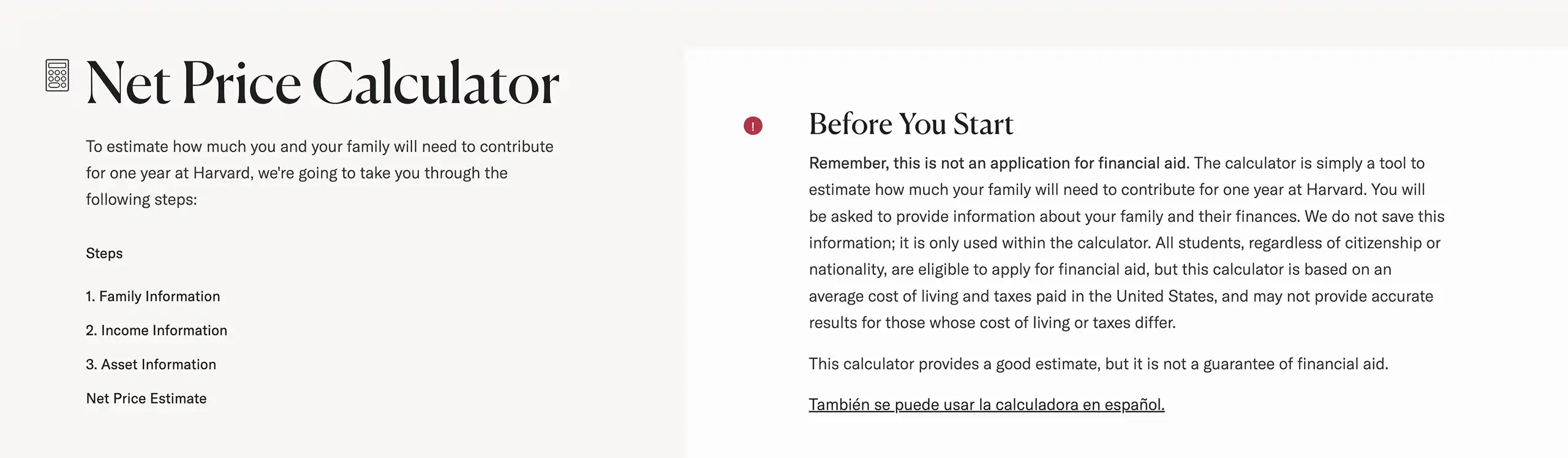
When researching the US college system to decide where you want to apply, make sure you investigate financial aid early in the research process so you can identify colleges where aid is available for international applicants. By law, every US college website must have a net price calculator or similar tool that allows prospective candidates to find out if they are eligible for financial aid, and if so, roughly how much they are likely to receive. Use the tool on the websites of all your long-listed colleges as one way of choosing your final shortlist. If applying to Harvard, our Net Price Calculator is user-friendly with only four fields, making it easy to estimate your likely financial aid package.
2. Apply for financial aid at the same time as you apply for admission
So that any offers of admission you receive are accompanied by a financial aid offer. That way, you can make an informed choice about whether to accept or decline any offers you receive. A good time to start filling out your financial aid forms is during the summer holiday before your final year at secondary school, shortly after the main US college application platforms (Common Application and Coalition Application) go live on 1st August each year.
3. Complete the necessary financial aid documents and submit the appropriate tax returns and supporting information.
International applicants will need to submit the following documents:
- College Scholarship Service (CSS) Profile
- Institutional Documentation Service (IDOC) Packet
- The annual tax return used in your home country – for UK applicants, this will be the HMRC Tax Returns
- Other information about your family’s business interests, unusual expenses or special circumstances
(At Harvard, the deadlines for submitting these documents are 1st November for Restrictive Early Action applicants, or 1st February for Regular Decision applicants).
4. Complete the CSS Profile for 2026/27
Start by clicking the ‘Sign in to Fall 2026/Spring 2027’ button and then fill out the CSS Profile. This is an online financial aid application, administered by the College Board, used to determine a family’s financial need for institutional financial aid, and is suitable for both US citizens and international applicants. It is used by about 400 colleges, universities and scholarship programs in the US, including Harvard, and allows international applicants to report financial information in their country’s currency.
5. Submit your IDOC Packet
After you have completed your CSS Profile, the next task is to submit all your financial aid documents online using the Institutional Documentation Service (IDOC). The College Board will then provide the documents automatically to all the colleges to which you are applying. As with the CSS Profile, the IDOC Packet is necessary both for domestic and international applicants. To see a 14-minute video which introduces IDOC and guides you through its use, go to the IDOC Homepage, scroll down to ‘Overview’ and click ‘Open Presentation.’ On the following page click ‘Start’ and then enter ‘2027’ as your high school graduation year.
For Harvard Applicants
IDOC will show a list of basic documents to be uploaded, but it is not the definitive list of what you need to submit. Additional required documents are given below. Gather all of the following that apply and submit them to IDOC. Do not send draft or estimated taxes. The Financial Aid Office needs the actual tax return as filed with your government.
- Most recent HMRC Tax Return (UK applicants) for both parents.
- Student’s tax return (if you have submitted one).
- Business documents – if either of your parents has an interest in a business or farm, submit the latest business tax return.
- Trust or estate documents – if you or your parents are the beneficiary of an estate or trust, submit the full trust tax return and a letter explaining the contents of the trust or estate, its value, and accessibility.
- Additional information – if you have any unusual expenses or special circumstances to share, submit an explanatory letter with the rest of your documents.
How to Use Harvard’s Net Price Calculator
Renewal and Reconsideration
To accommodate changes in circumstances, Harvard’s Financial Aid Office has renewal and reconsideration processes in place.
Currently enrolled financial aid recipients automatically receive emailed instructions to apply for renewal in February. Students who have not applied for aid in the past but whose circumstances have changed may contact the Financial Aid Office to start a new application.
If a financial aid recipient’s family experiences a significant change in circumstances after the application for financial aid is processed, the student or family may request a review of the financial aid award. The Financial Aid Committee meets on a regular basis throughout the year to discuss appeals for more aid.
Other US colleges that are ‘need-blind’ and provide the ‘full demonstrated need’ for international students
- is “need blind” with respect to admission – Amherst will not take into account whether you have applied or intend to apply for financial aid in the admission process
- will meet 100% of your calculated financial need
- your financial aid offer will not contain any initially packaged student loans
Bowdoin College
Bowdoin College is need blind for international students. That means your family’s ability to pay is not a factor or barrier to admission. If you require financial assistance to attend college, Bowdoin will work closely with you and your family to ensure your financial aid meets your need.
Dartmouth College
Dartmouth College has scholarships and loans available to international students, which includes an allowance for travel to the U.S. We understand that your circumstances may be unique and our office will help in any way we can. Dartmouth has expanded its longstanding need-blind admissions policy to include all international citizens, beginning with the Class of 2026.
Massachusetts Institute of Technology (MIT)
International students are considered for aid using the same process that we use for all applicants. We are committed to meeting 100% of demonstrated financial need for international students just as we are for domestic students.
Princeton University
The full need of all admitted international students is met the same as it is for students from the United States. Your family’s ability to pay for your university education is not a factor in our admission decision. Our financial aid program is entirely based on need. Princeton does not offer academic or athletic merit scholarships.
Yale College
Yale operates a need-blind admissions policy for all applicants, regardless of citizenship or immigration status. Yale admits undergraduate students without regard to their ability to pay, and provides need-based financial aid awards to all admitted students on the basis of individual needs assessments. All of Yale’s undergraduate financial aid is awarded on the basis of financial need. There are no merit-based or academic scholarships.
150th issue of the Harvard Club of the UK’s outreach newsletter
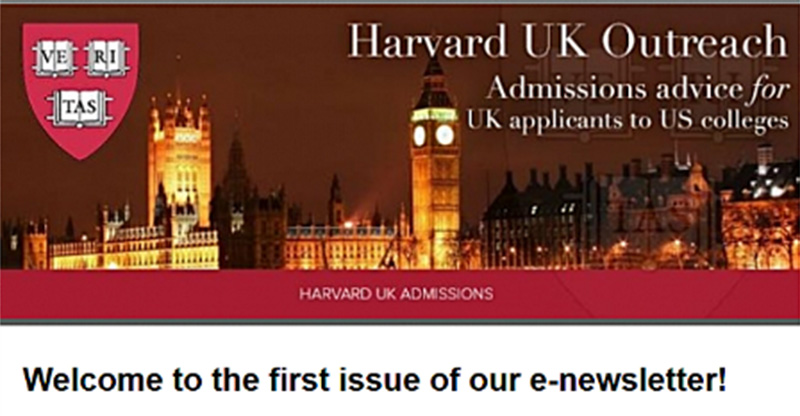
1st issue: September 2013
The newsletter was originally conceived as a follow-up to the HCUK’s school presentations for those students who wanted to make an application to US colleges but didn’t know where to start. To sign up, students and parents had to write their names and email addresses manually on a paper form at the end of the presentation.
50th issue: October 2017
By the time of the 50th issue, we had reached a ceiling of over 2,000 UK subscribers, which has been maintained ever since.
100th issue: December 2021
By the 100th issue, the newsletter was being read in over 30 countries outside the UK.
150th issue: February 2026
By this month’s 150th issue, all new subscribers to the newsletter could sign up from the homepage of HCUK’s Harvard UK Admissions website. The 12 most recent back issues are now also kept on the website so that visitors can review the whole one-year admissions cycle in one sitting.
If you enjoyed reading this newsletter and wish to receive future newsletters, click here to subscribe.