
Harvard Outreach Newsletter
147th Issue, November 2025
In this issue:
- School Visits Programme January - April 2026
- Sutton Trust Fulbright US Programme 2026
- Teachers and university advisers - what information do you need to provide to US colleges in support of your students?
School Visits Programme January - April 2026
Want to learn more about Harvard and American-style higher education? Then invite us to give a presentation at your school next term.
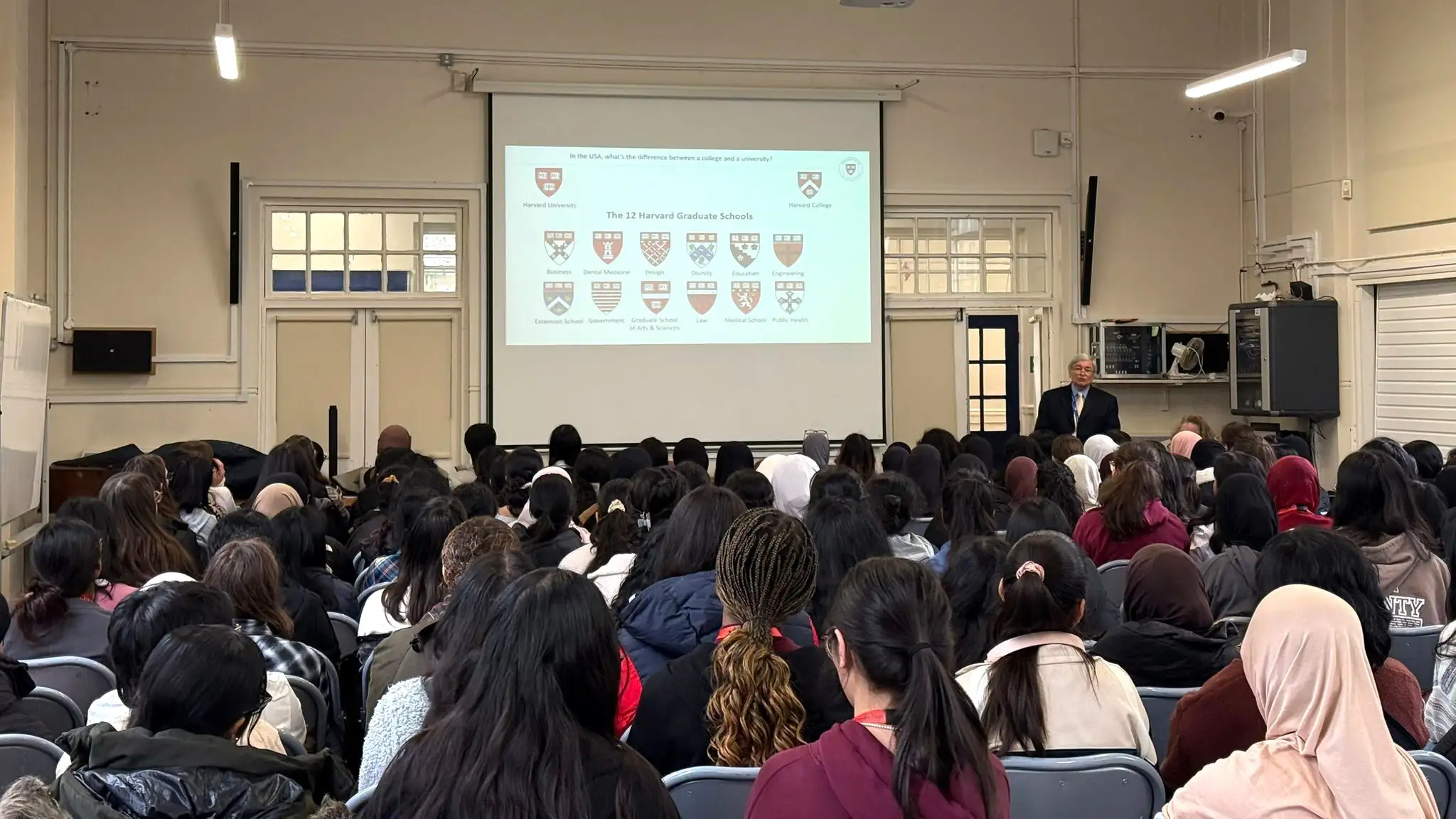
Each year volunteers from the Harvard Club of the UK visits schools across the country to talk about Harvard and the American higher education system. The session is entitled: Study in the USA – Is it for you? and is aimed at students who are thinking of applying to Harvard and other US colleges either next year or the year after but would like further information before making up their minds.
Target audiences are students in Years 11 & 12 (England & Wales); S4 & S5 (Scotland); and Years 12 & 13 (N. Ireland). Parents, teachers and university advisers are also welcome to attend. The size and format of the meeting is entirely up to the school. Some schools like to arrange large evening events to which parents are invited, while others prefer smaller seminar-style meetings during the school day for students who have already expressed an interest in studying in the US. Either way, the presentation lasts for 40 minutes plus time for questions – a total length of 45-60 minutes.
To request a visit, send an email to school visits co-ordinator Stuart Gordon at schools@hcuk.org giving the name and location of your school and roughly when you would like the presentation to take place. We welcome requests from both teachers and students, but if you are a student, please seek the approval of the appropriate member of staff (the Head of Sixth Form or the teacher in charge of university applications) before you write to us.
We look forward to meeting you!

Applications are now open for the Sutton Trust Fulbright US Programme 2026.
This is a once in a lifetime opportunity to explore what studying in the US is like. It will give you a taste of what it’s like being an international student in the US and help you see if it could be the right fit for you.
The Programme was founded, and is funded, by the Sutton Trust, the UK’s leading social mobility charity, and is delivered in partnership with the US-UK Fulbright Commission who are experts in helping UK students study in the US. It’s a fully funded programme so they will cover all costs, including travel, residential events, accommodation and food.
Format and key dates for 2026 Programme
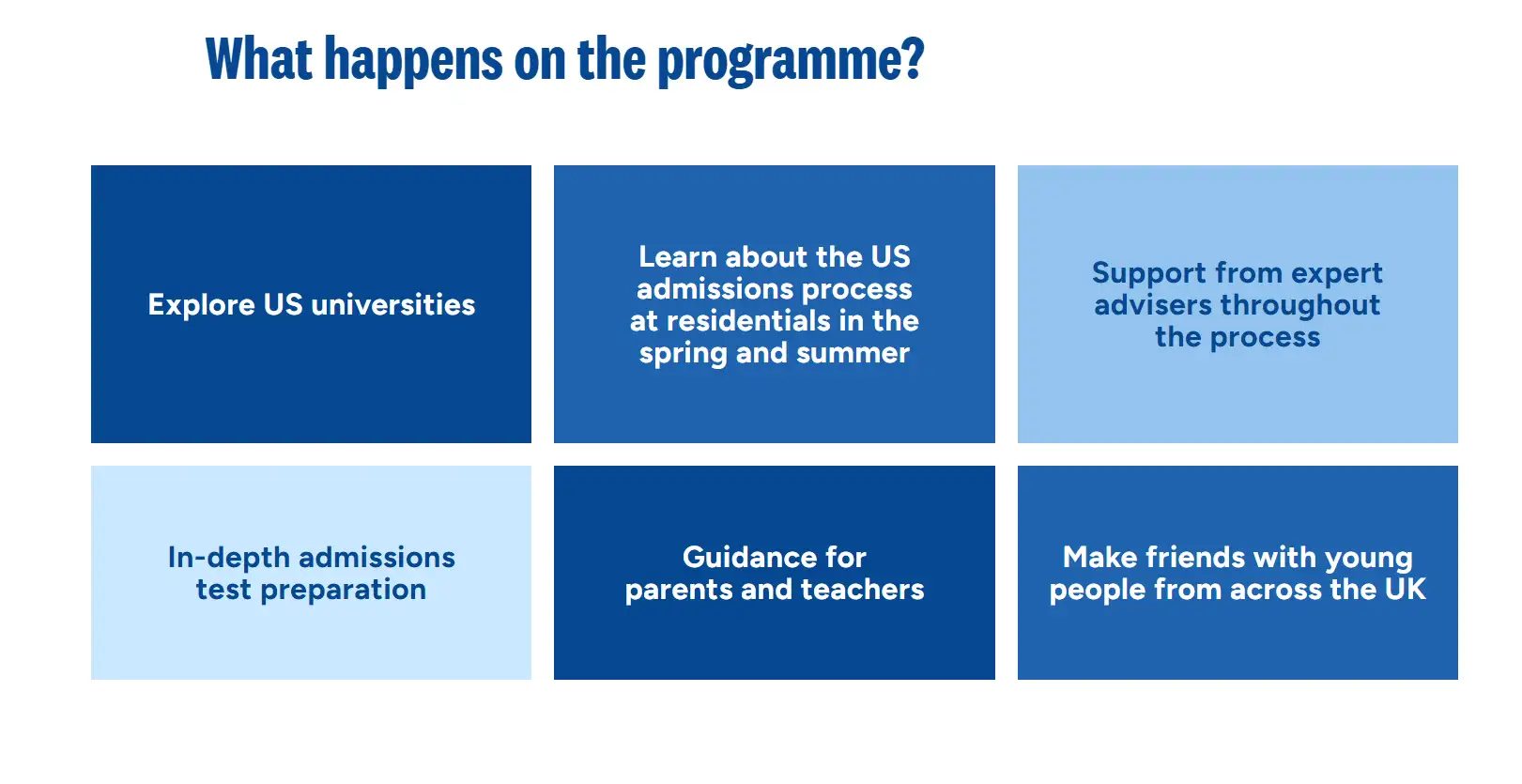
Part 1
11 January 2026 – Student application form deadline.
Late February 2026 – Application decisions released.
31 March – 2 April 2026 – April residential. At the April residential you’ll meet your cohort from across the UK. This action-packed residential will allow you to hear from current students, alumni of American universities and experts in the admissions field.
6 June 2026 – Sit the SAT admissions exam. You’ll sit the SAT admissions exam at a testing centre. Students will be expected to study on their own for the SAT, however, you will receive support both at the April residential and online in the run up to the exam.
5 – 7 June 2026 – June residential. You will begin to work on elements of the US admissions application, such as essays and the extracurricular list.
May, June and July 2026 – Foundations of a US application. Working through the Programme’s bespoke modular course, you will learn how to write about yourself, your world view and your achievements. These will form the building blocks of a US application in the autumn.
21 July – 4 August 2026 – Summer residential. At the summer residential, you will spend time learning more about the US admissions process, deepen your understanding of what it is like to study at US universities by meeting programme alumni who are studying there, and connect with US university admissions representatives. During this residential, you will start to decide if studying in the US is the right choice for you. The summer residential will take place at a UK university. Please note that, while Programme administrators work to confirm the dates for this residential, you should be available for the entire period.
August 2026 – Apply to Part 2. If you decide you would like to apply to US universities during the Autumn Term 2026, you can apply to join the second part of the programme.
Part 2
25/26 September 2026 – Attend USA College Day. Fulbright’s USA College Day is the largest US college fair in Europe. You’ll receive a VIP pass to access the admissions officers at the fair before anyone else.
September 2026 – January 2027 – Apply to US universities. At this point you’ll submit your application to your university choices. The application process has multiple stages and deadlines. The Fulbright advisors will guide you through this process, including how to apply for financial aid.
December 2026 – December event. At this one-day event, you will prepare for the early application results and work on your regular round applications.
July 2027 – Pre-departure event. In July 2027, the Programme staff will celebrate all the students on the programme at a pre-departure event hosted in London. You’ll be joined by the rest of your cohort, parents, staff members, donors and programme alumni to celebrate your achievements.
To be eligible to apply, you must:
- Currently be in Year 12 in England or Wales, S5 in Scotland or Year 13 in Northern Ireland.
- Attend, and have always attended, a state-funded, non-fee paying school or college
- Not hold US citizenship.
- Be from a low or middle income family (generally, this will mean a household earning £50,000 per year or less).
- Be interested in US culture and higher education.
Additional criteria:
In addition, they are looking for students who:
- Have excellent GCSEs or S4 qualifications. This means you have achieved at or close to the following grades. In England and Northern Ireland: at least eight GCSEs at grade A or 7 or above, or near this level. In Wales: at least eight GCSEs at grade A or above, or near this level. In Scotland: at least six B passes at National 5 or above, or near this level.
- Would be the first generation of their family to attend university.
- Have been eligible for free school meals while at secondary school.
- Attend a school or college with a below average attainment and/or a low rate of progression into the top third of higher education institutions.
- Live in a neighbourhood with a low rate of progression into higher education and/or a high level of socio-economic deprivation.
- Have been looked after or in care.
The more of these you meet, the more likely you are to get a place on the programme. There is room on the application form and teacher reference to explain any extenuating circumstances that might impact your application.
Selection criteria
Students will complete an online application modelled on the US Common Application and Financial Aid forms. This will help the programme admissions officers to conduct a holistic review of your application, and will get students in the mindset of the US admissions process.
- Academic performance and potential.
- Extracurricular involvement, including school and community activities, work experience, paid work, sports and music performance, volunteering, caring responsibilities and other interests.
- Character: this includes leadership, service, work ethic, enthusiasm, drive to succeed.
- Demonstrated interest in US higher education.
Applications: Students should apply online here
Student application form deadline: 11.59pm, Sunday 11 January 2026
School reference form deadline: 11.59pm, Wednesday 14 January 2026
Applicants will be notified of the outcome at the end of February 2026.
Teachers providing references should read the Sutton Trust’s information for teachers.
The Sutton Trust also provides information for parents.
Teachers and university advisers - what information do you need to provide to US colleges in support of your students?
If you are a teacher with responsibility for supporting students with their UCAS applications, but are unfamiliar with the US college application system, this article will provide you with information about what your school needs to provide in terms of reports, student transcripts and references. Additional information can be found on the ‘School Counselors’ page of the Harvard College website, which includes an excellent video ‘5 Harvard Facts in 3 Minutes,’ covering financial aid, support resources, documents to submit, fast Harvard facts, and ‘Who are we looking for?’
Although not all US colleges accept the Common Application Form, or ‘Common App,’ it is nevertheless used by over 1,000 institutions, including all the top research universities, so a large majority of applicants and advisers are likely to use this platform. The main documents that schools need to provide are:
- School Profile – description of the school and its community.
- Student Transcript – record of the student’s exam grades and predicted grades.
- Counselor Reference (also known as the ‘Secondary School Report’ at Harvard) – a character reference written by the Head of Sixth Form or other senior member of staff.
- Teacher Reference – an academic reference written by one or more of the student’s current subject teachers.
The School Profile is a description of the school and the community it serves. Context is very important for a US college application as it helps admissions officers to make sense of the numerical data. The US-UK Fulbright Commission provides a helpful template under the ‘School documents’ section. It suggests that, in general, the school provide the following information:
- Type of school (in the USA, “public” means state funded, and academies are comparable to charter schools)
- Admissions process, if applicable
- School history and cultural/local information
- School ethos, mission statement or ideology
- Quotes from inspection reports or the press
- League table position (especially important if the school is ranked low but your grades are excellent)
- Student body (demographics, single sex or mixed, class size, etc)
- Percentage of university enrolment (broken down by Oxbridge, Russell Group, etc if possible)
- If your school ranks pupils by performance or not (this is common in the USA, so readers will expect your class rank if there is no explanation)
The Student Transcript is a document produced by the school as an official record of a student’s academic performance. The US-UK Fulbright Commission suggests that the one page [two side] school transcript should include:
- Official school letterhead, stamp and signature
- Years attended
- Achieved and predicted national grades from the last four years of secondary education (Years 10-13 in England and Wales, S3-6 in Scotland, Years 11-14 in Northern Ireland)
- Academic honours and awards
- Explanations and equivalencies of new or unfamiliar qualifications for university entry (EPQ, Pre-U, Welsh Baccalaureate, BTEC, etc)
- Information about how curriculum reforms relate to a student’s subject choices
- Plans to resit any exams
- Extenuating circumstances
- How your choice and number of subjects compares to the average student
If the student changed schools within the four years before graduating, the school should ask their previous school to produce a similar document. Like the reference letters, the transcript must be submitted directly by the school.
Different templates corresponding to the exam systems used in different parts of the UK can be viewed on the Fulbright Commission website at the end of the ‘School documents’ section.
The Counselor Reference (or Secondary School Report) places applicants within the context of their entire year group and school community, and should address the student’s academic performance, extracurricular achievements and personal qualities. In the US, this reference would be written by the school’s College Counselor, and the nearest UK equivalent of this role is the Head of Sixth Form or teacher in charge of university applications.
The Teacher Reference should focus on the student’s qualities as a scholar: intellectual curiosity, creative thought, quality of writing, class behaviour and work habits. The student may request either one or two teacher references from their current subject teachers.
Common App Recommender Guide
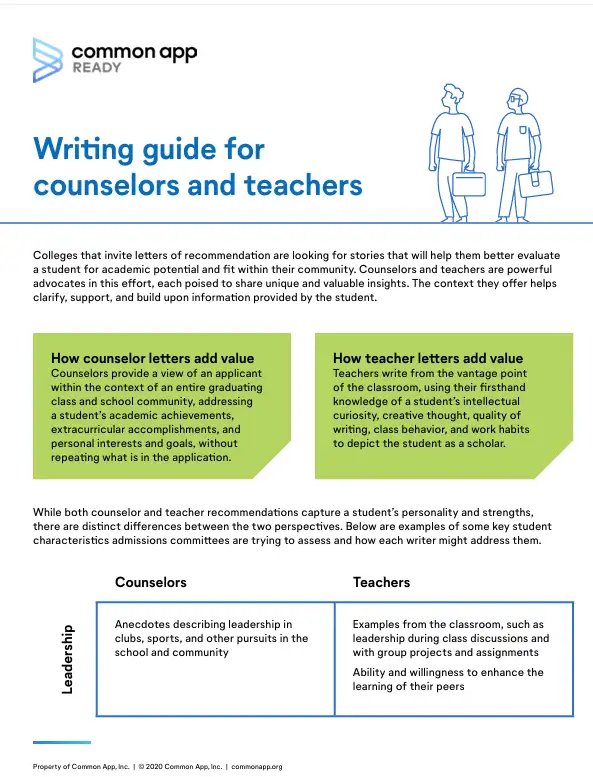
Writing guide for counselors and teachers
While both counselor and teacher recommendations capture a student’s personality and strengths, there are distinct differences between the two perspectives. This document gives examples of some key student characteristics admissions committees are trying to assess and how each writer might address them.
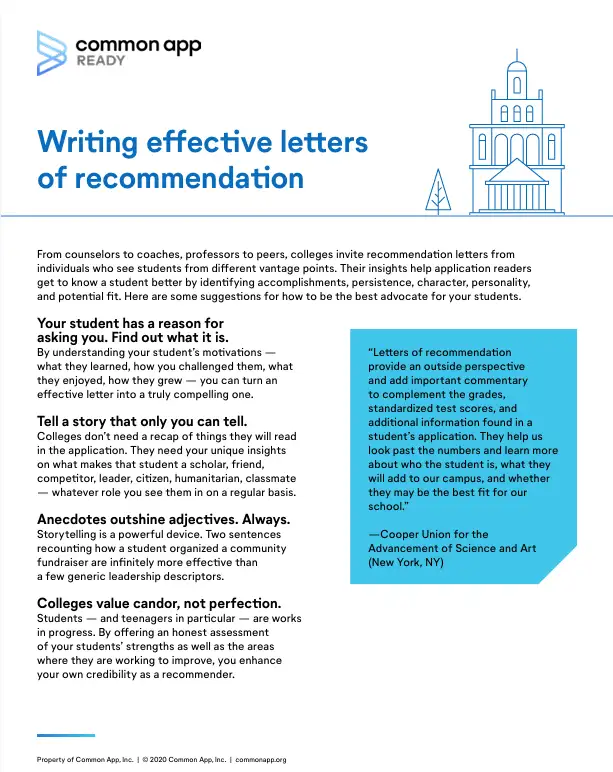
Writing effective letters of recommendation
Useful tips on the content of an effective student reference.
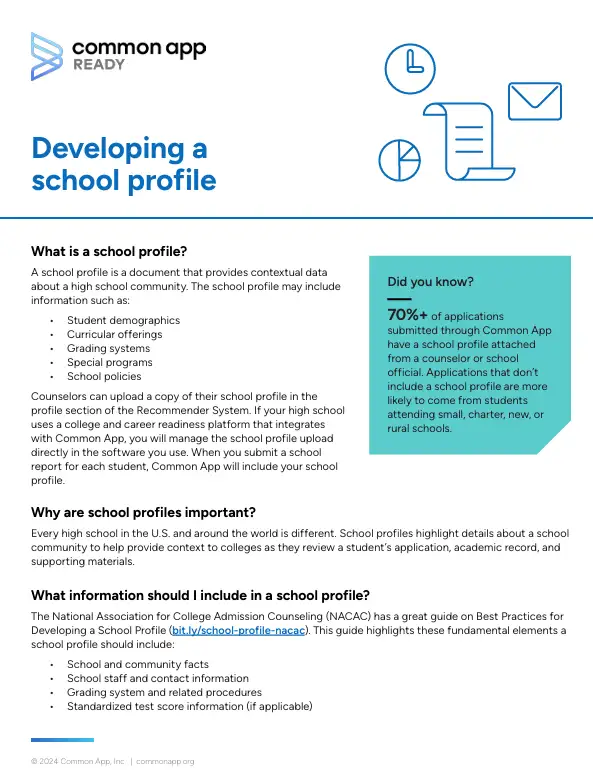
Writing guide for counselors and teachers
What is a school profile? Why is it important? What information should it include? Additional information about the school profile which complements that provided by the Fulbright Commission (see the ‘School Profile’ section above).
If you enjoyed reading this newsletter and wish to receive future newsletters, click here to subscribe.